
Energy efficiency has been part of letting a property in England since 2018, and the standard landlords must meet is set to rise. The government has now published its final policy position, although the legislation to implement it is still to come. This article separates what is law today from what has been announced, and sets out what landlords should be thinking about between now and 2030.
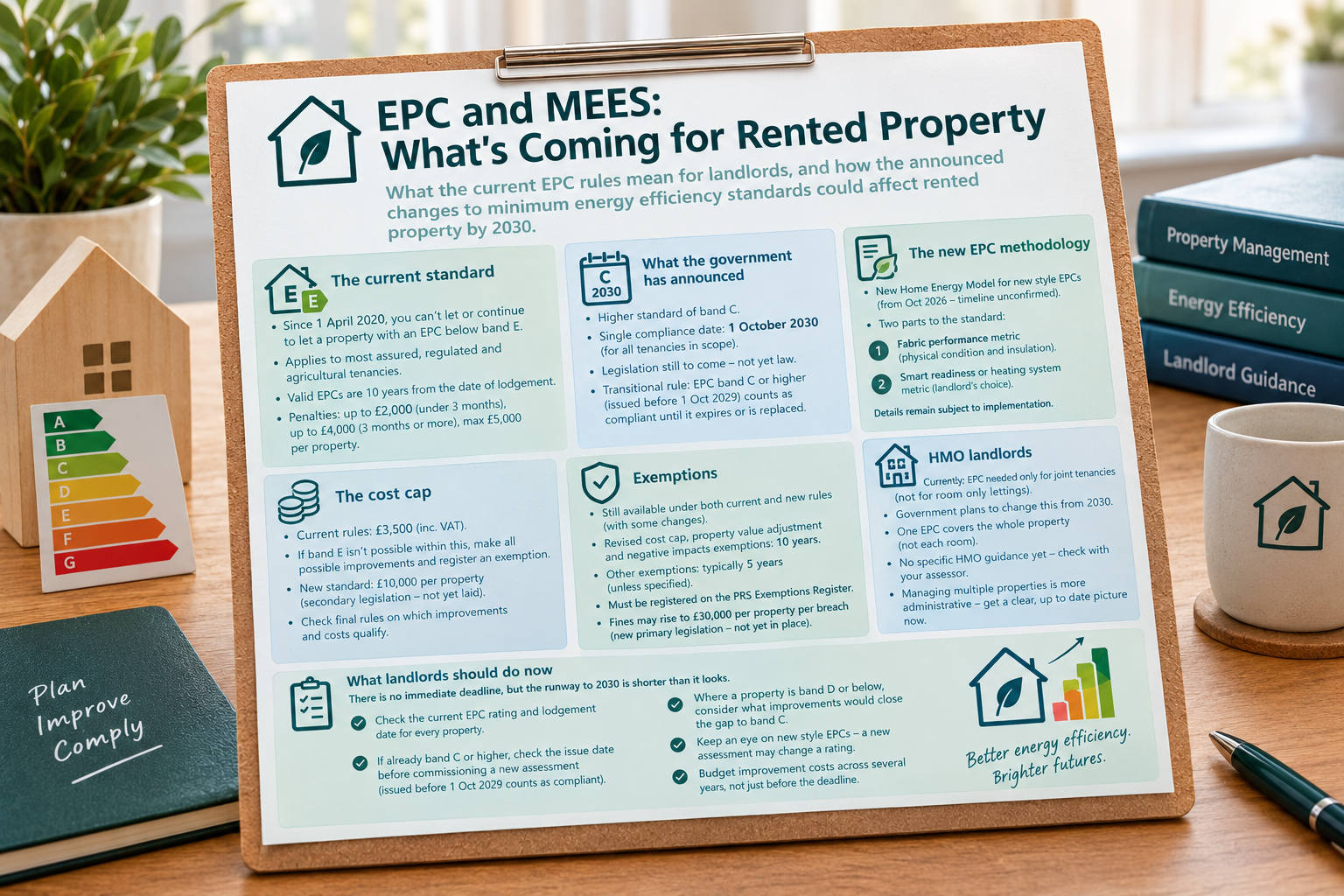
The current standard
Since 1 April 2020, private landlords have not been able to let, or continue to let, a domestic property with an EPC rating below band E. This applies to every tenancy, new or continuing, and covers most assured, regulated and agricultural tenancies where an EPC is legally required.
A property that has been marketed for sale or let, or modified, within the past 10 years will probably be legally required to have a valid EPC. Certificates remain valid for 10 years from the date they are lodged, which means some landlords are relying on certificates issued some years ago without having checked whether changes to the property since then would affect the rating.
Under the current domestic regime, letting a property below band E without a registered exemption can lead to a penalty of up to £2,000 where the breach lasts under 3 months, or up £4,000 where it lasts 3 months or more. The maximum penalty is £5,000 per property in total.
What the government has announced
Following a consultation that closed in 2025, the government published its response in January 2026. It sets a higher standard of band C, with a single compliance date of 1 October 2030 for all tenancies in scope. There will not be an earlier date for new tenancies.
These are policy decisions, not yet law. The government has said the changes need Parliamentary approval, that it will seek new powers by Act of Parliament, and that it aims to lay a statutory instrument to come into force in 2027. Until then, the current band E requirement applies.
The government has also announced a transitional rule. A property with an EPC rated band C or higher on the current Energy Efficiency Rating issued before 1 October 2029 will count as compliant with the higher standard until that certificate expires or is replaced.
The new EPC methodology
A new assessment methodology, the Home Energy Model, will be used for new style EPCs. The government aims to deliver new EPCs from October 2026, but describes that timeline as ambitious, and has not yet confirmed how the band C threshold will look on the new certificates.
The announced standard has 2 parts. The primary standard is set against a fabric performance metric, which reflects the physical condition and insulation of the building. The secondary standard is set against either a smart readiness metric or a heating system metric, and the choice is at the landlord's discretion. The details remain subject to implementation.
The cost cap
Under the current rules, landlords are not required to spend more than £3,500 including VAT on energy efficiency improvements. Where a property cannot reach band E within that amount, the guidance says to make all the improvements possible up to the cap and then register an exemption. The cost cap does not mean landlords can skip eligible works.
For the new standard, the government has announced a cap of £10,000 per property on required investment. This will be set in secondary legislation that has not yet been laid, so landlords should check the final rules, including which improvements and costs qualify, before committing to major works.
Exemptions
Exemptions remain available under the current rules for situations such as the cheapest recommended improvement exceeding the cost cap, or third party consent being refused. The government has announced that exemptions will continue under the higher standard, with some changes. The revised cost cap exemption, the property value adjustment exemption and the negative impacts exemption are intended to be valid for 10 years, and other exemptions are typically valid for 5 years unless specified.
Exemptions must be registered on the national PRS Exemptions Register to count, and the draft PRS Database regulations will ask whether a property below the minimum level has a registered exemption, so landlords relying on one should keep the details to hand. The government has also said it intends the maximum fine to rise to £30,000 per property per breach. This would need new primary legislation and does not apply today.
HMO landlords
Industry guidance indicates that an EPC is currently needed only where a property is let on a joint tenancy, not for room only lettings, that the government plans to change this from 2030, and that a single EPC covers the whole property rather than each room. The government's published landlord guidance does not address HMOs, so landlords should confirm with their assessor which EPC applies to each letting.
For HMO landlords managing several properties, often of different ages and construction types, this is a bigger administrative task than for a single let portfolio. Getting a clear, up to date picture of where each property currently stands is the most useful first step, well ahead of any works being needed.
What landlords should do now
There is no immediate deadline, but the runway to 2030 is shorter than it looks once retrofit works, planning permissions and contractor availability are taken into account.
- Check the current EPC rating and lodgement date for every property in a portfolio.
- If a property already has an EPC rated band C or higher, check its issue date before commissioning a new assessment, because certificates issued before 1 October 2029 are due to count as compliant until they expire.
- Where a property sits at band D or below, start considering what improvements would close the gap to band C.
- Keep an eye on the rollout of new style EPCs, since a new assessment may change a property's rating even without physical works.
- Budget improvement costs across several years rather than leaving them until close to the deadline.