
The Register Your Rental Property service is scheduled to open on 15 December 2026. Once your region is called forward, you will need to register yourself as a landlord and register each property you let on an assured or regulated tenancy, then keep those entries up to date. This guide sets out what to do now so that registration is a short task rather than a scramble.
A note on status. The detailed rules sit in the draft Private Rented Sector Database Regulations 2026, published on 9 September 2026. This article reflects the draft and current government guidance as at 21 October 2026, and some details may change before the regulations are finalised.
What registration involves
Each landlord creates a landlord entry, then a separate dwelling entry for each property. Government guidance sets the fee at £65 per property per year, and the fee is adjusted during the rollout so that landlords who sign up first do not pay more. You will need a GOV.UK One Login to use the service, and offline routes will be available for landlords who need them.
Initially the requirement applies to properties that are let, or that become occupied, during the rollout. An empty property does not need an entry until it is let on an assured tenancy. Government has said that future legislation will also require landlords to register before marketing a property to let, with registration numbers shown on adverts. No date has been set for that.
Key dates
Registration opens on 15 December 2026, and any property can be registered from that date, even if your region has not yet been called forward. The legal requirement is then phased region by region, with each region given 3 months to register.
|
Region |
Requirement starts |
Register by |
|
West Midlands |
15 December 2026 |
14 March 2027 |
|
East of England |
15 January 2027 |
14 April 2027 |
|
East Midlands |
15 February 2027 |
14 May 2027 |
|
South East |
15 March 2027 |
14 June 2027 |
|
Yorkshire and Humber |
15 April 2027 |
14 July 2027 |
|
North West |
15 May 2027 |
14 August 2027 |
|
North East |
15 June 2027 |
14 September 2027 |
|
London |
15 July 2027 |
14 October 2027 |
|
South West |
15 August 2027 |
14 November 2027 |
Reading, Wokingham, West Berkshire, Bracknell Forest, Slough, Windsor and Maidenhead, Oxfordshire, Buckinghamshire, Surrey and Hampshire all fall within the South East region in the draft regulations. For those properties the requirement starts on 15 March 2027 and the deadline is 14 June 2027. Government has said that all landlords actively letting property must be registered by 14 November 2027.
Your checklist
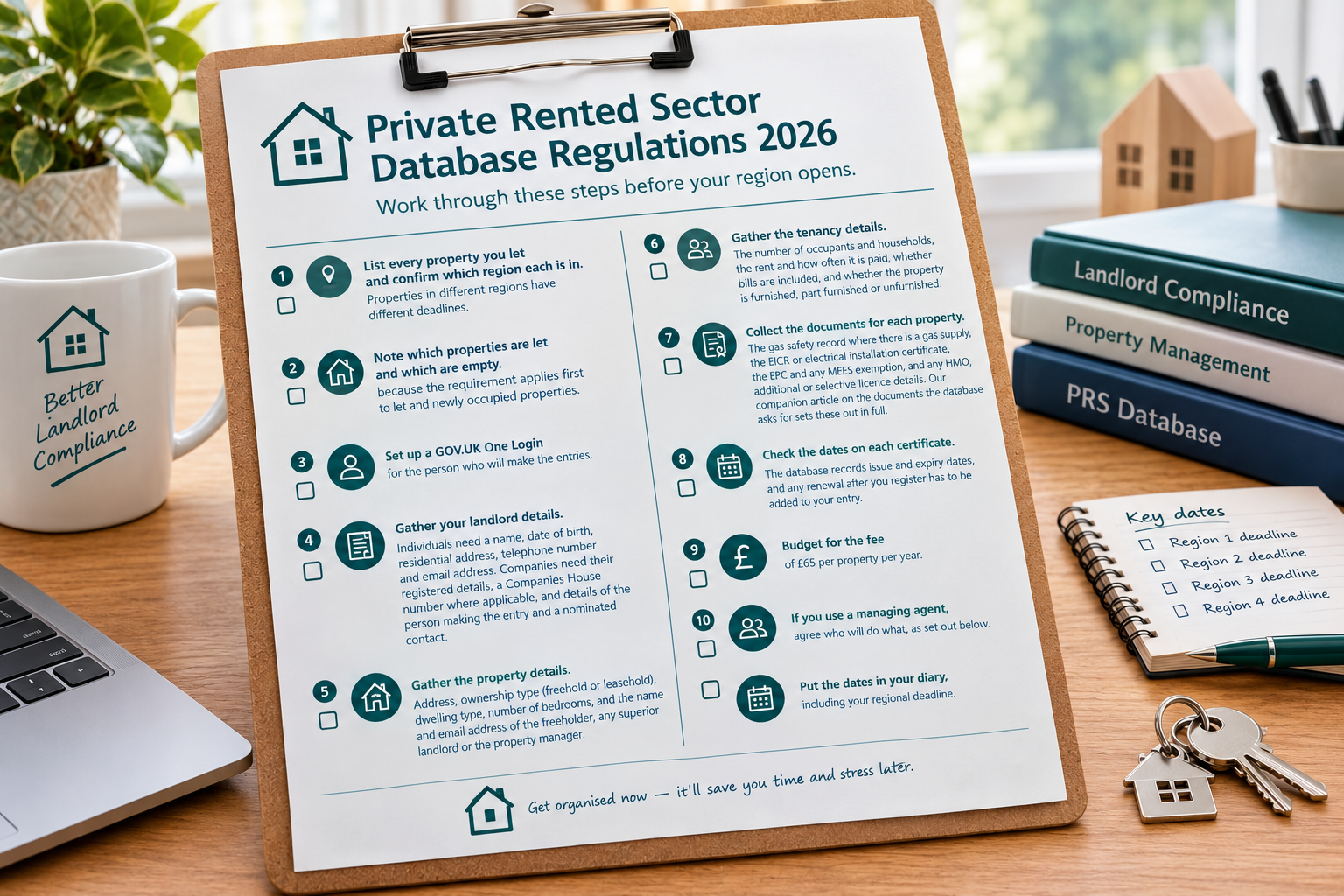
Work through these steps before your region opens.
- List every property you let and confirm which region each is in. Properties in different regions have different deadlines.
- Note which properties are let and which are empty, because the requirement applies first to let and newly occupied properties.
- Set up a GOV.UK One Login for the person who will make the entries.
- Gather your landlord details. Individuals need a name, date of birth, residential address, telephone number and email address. Companies need their registered details, a Companies House number where applicable, and details of the person making the entry and a nominated contact.
- Gather the property details: address, ownership type (freehold or leasehold), dwelling type, number of bedrooms, and the name and email address of the freeholder, any superior landlord or the property manager.
- Gather the tenancy details: the number of occupants and households, the rent and how often it is paid, whether bills are included, and whether the property is furnished, part furnished or unfurnished.
- Collect the documents for each property: the gas safety record where there is a gas supply, the EICR or electrical installation certificate, the EPC and any MEES exemption, and any HMO, additional or selective licence details. Our companion article on the documents the database asks for sets these out in full.
- Check the dates on each certificate. The database records issue and expiry dates, and any renewal after you register has to be added to your entry.
- Budget for the fee of 65 pounds per property per year.
- If you use a managing agent, agree who will do what, as set out below.
- Put the dates in your diary, including your regional deadline.
Timing rules to know
- Initial information: an entry can be made before all the property information is supplied, but the tenancy, health and safety information and documents must be provided within 28 days of the entry being made. These cover occupants, households, licences, gas, electrical, EPC, rent and furnishing. A property entry for a let property becomes inactive if they are not provided in time.
- Changes: anything that later changes must be updated within 28 days. Typical examples are a renewed gas or electrical certificate, a new EPC or MEES exemption, a rent change or a change in the number of occupiers.
- Entries must be renewed every year, and renewal needs the fee to be paid. Property entries made later share the renewal date of your existing entries.
- A landlord entry becomes inactive if no property entry is linked to it within 3 months.
If you use a managing agent
The draft regulations say the landlord must make the entries, unless a narrow exception applies, such as a personal representative or someone holding power of attorney. An agent cannot register on the landlord's behalf. An agent or property manager appointed by the landlord can, however, provide the tenancy, health and safety information and documents, and can update that information. Government has said it will publish guidance for agents on what they can provide and how. Until it does, landlords should agree with their agent who holds each document, who will supply it and who will track the 28 day updates.
HMO landlords
The database asks for the number of occupants, the number of households and licence details, including any HMO, additional or selective licence number where available. The published guidance we have seen does not say how a multi room HMO is counted for the fee, for example as 1 property or by room. Until that is confirmed, avoid committing to a firm fee budget for multi room HMOs, and check the final guidance before paying.
What happens if you do not register
The Renters' Rights Act gives councils the power to issue civil penalties of up to £7,000 for breaching the registration duties, and of up to £40,000 for knowingly or recklessly giving false or misleading information, or for repeating or continuing a breach after a penalty. These are maximum amounts, not fixed fines. The Act also provides that a court cannot make a possession order while a landlord is in breach of the duty to have active entries, other than on Ground 7A or Ground 14. The NRLA has said that further legislation is needed before councils can use these enforcement powers, so the enforcement timetable is not yet confirmed and landlords should check the position before relying on any date. Registering on time avoids the question.
What to do this month
Set up your One Login, list your properties by region, gather your certificates and agree responsibilities with your agent. If your properties are in the South East, your deadline is 14 June 2027, but registration opens on 15 December 2026, so there is time to do it early and calmly. Check GOV.UK for the final regulations and guidance before you register.