
Winter puts HMOs under more strain than any other time of year. Heating runs harder, windows stay shut, pipes face frost and evenings are dark early. Several legal duties matter most at exactly this point. This checklist covers the main ones for HMO landlords in England, based on legislation and government guidance as at 21 October 2026.
Heating and hot water
Section 11 of the Landlord and Tenant Act 1985 requires a landlord to keep in repair and proper working order the installations for space heating and heating water. The HMO manager has separate duties under the Management of Houses in Multiple Occupation (England) Regulations 2006: fixtures, fittings and appliances within living accommodation must be kept in good repair and clean working order, and appliances shared by 2 or more households must be kept in good and safe repair. A heating failure in January is a legal problem as well as a tenant experience problem.
Gas safety
Every gas appliance and flue provided for tenants needs a gas safety check by a Gas Safe registered engineer every 12 months. Under the statutory conditions, the check can be done up to 2 months before the deadline without losing the original deadline date. Landlords must keep the record for 2 years, give existing tenants a copy within 28 days of the check and give new tenants a copy before they move in. In an HMO, the manager must also supply the latest gas appliance test certificate to the council within 7 days of a written request.
A gas safety check is not the same as a boiler service. The check is the legal annual duty. HSE also says landlords must maintain gas appliances and flues in a safe condition, that no timeframe is prescribed, and that regular annual maintenance is good practice.
Smoke and carbon monoxide alarms
Under the Smoke and Carbon Monoxide Alarm (England) Regulations 2015, as amended in 2022, private rented homes need at least one smoke alarm on each storey used as living accommodation and a carbon monoxide alarm in any room used as living accommodation that has a fixed combustion appliance, excluding gas cookers. Landlords must make sure alarms work on the day a tenancy begins and repair or replace faulty alarms once told. These regulations apply to unlicensed HMOs. Licensed HMOs are exempt from them, because HMO licensing law imposes similar requirements instead.
For a licensed HMO, the alarm requirements therefore come from the licence conditions, your fire risk assessment and the fire safety standards that apply to the property, rather than from the general minimum. Check each of these, as councils can set requirements that go further. The HMO manager must also keep fire alarms and fire fighting equipment in good working order.
Frost, water and utilities
The HMO Regulations require the manager to protect any water fitting liable to frost damage from frost, and not to unreasonably cause or permit the water or drainage supply to be interrupted. The same applies to the gas and electricity supply. Void rooms and unheated areas deserve a specific check before the cold weather arrives.
Common parts and fire safety
Common parts must have adequate light fittings available for use at all times by every occupier, and windows and ventilation in common parts must be kept in good repair. With shorter days, check landing, stair and hallway lighting. Means of escape from fire must be kept free from obstruction and in good order. Winter habits such as drying laundry in hallways or storing bikes inside can block escape routes, so remind occupiers.
Damp, mould and cold
Damp, mould and cold are the most common winter concerns, and the law treats them seriously. Under the Housing Health and Safety Rating System, which councils use to assess hazards, inadequate heating is a deficiency linked to excess cold and to damp and mould. Where a council finds a Category 1 hazard it has a duty to take action, and government guidance tells landlords to keep their homes free of Category 1 hazards. Section 9A of the Landlord and Tenant Act 1985 also implies a term that a home is fit for human habitation. In an HMO, windows and ventilation in living accommodation must be kept in good repair.
A report of damp, mould or cold does not in itself mean a penalty. Penalties follow where a council has served an improvement notice and it is not complied with. For offences committed on or after 1 May 2026, failing to comply with an improvement notice can lead to a civil penalty of up to £40,000, and a rent repayment order can require repayment of up to 2 years of rent. Responding promptly to every report of damp, mould or cold, and keeping a record of what was reported and what was done, is the simplest protection.
Condensation often builds up when ventilation is poor, so check extractor fans, trickle vents, window seals and any shared drying arrangements as part of your winter inspection. Where a tenant reports mould, treat it as a prompt to look for the underlying cause, such as a leak, a failed heater or blocked ventilation, rather than only cleaning the surface.
Awaab's Law and what is coming
Awaab's Law currently applies to social housing only. Government is consulting on extending it to private rented tenancies and to accommodation occupied under licence, and the consultation closes on 18 December 2026. The government's January 2026 policy statement says the new Decent Homes Standard will apply to private rented homes from 2035. Landlords who already respond quickly to damp and mould will be best placed if the rules are extended.
Licence conditions
HMO licence conditions vary between councils, and some require, for example, that gas safety certificates are sent to the council each year. Read your licence conditions and check that any deadlines fall before the cold weather.
A simple pre winter routine
Most winter problems can be reduced by a short routine carried out before the cold weather settles in. This is practical advice rather than a legal requirement, and it should be adapted to each property.
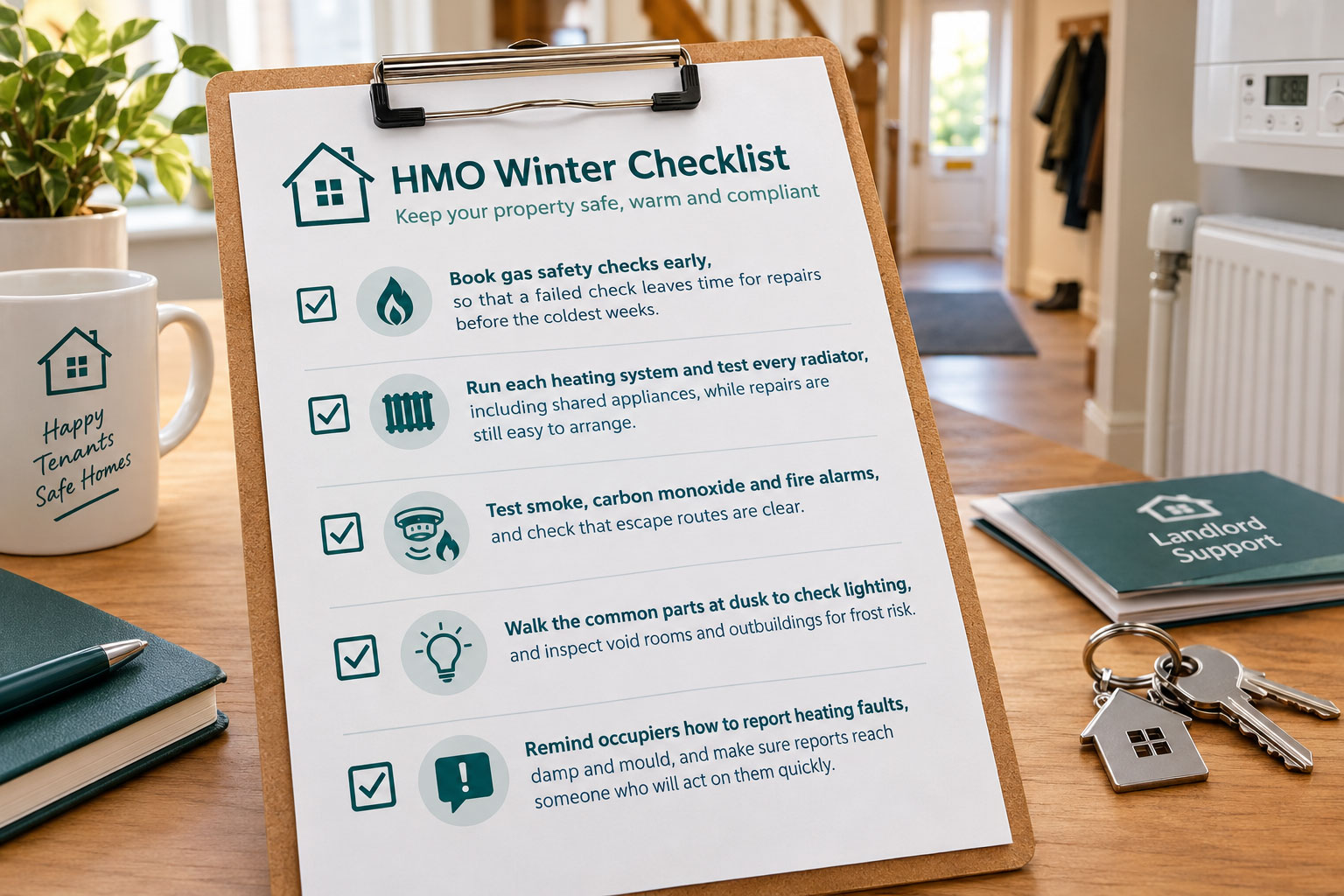
- Book gas safety checks early, so that a failed check leaves time for repairs before the coldest weeks.
- Run each heating system and test every radiator, including shared appliances, while repairs are still easy to arrange.
- Test smoke, carbon monoxide and fire alarms, and check that escape routes are clear.
- Walk the common parts at dusk to check lighting, and inspect void rooms and outbuildings for frost risk.
- Remind occupiers how to report heating faults, damp and mould, and make sure reports reach someone who will act on them quickly.
Winter checks at a glance
|
Area |
What to check |
Basis |
|
Heating and hot water |
Boilers, radiators and shared appliances working |
Landlord and Tenant Act 1985 s.11; HMO Regulations 2006 regs 7 and 8 |
|
Gas safety |
Record in date, copies issued |
Gas Safety (Installation and Use) Regulations 1998 |
|
Alarms |
Smoke and CO alarms working; for licensed HMOs, licence conditions and fire risk assessment |
Alarm regulations (unlicensed HMOs); HMO licence; HMO Regulations reg 4 |
|
Water and utilities |
Frost protection, no unreasonable interruption |
HMO Regulations regs 5 and 6 |
|
Common parts |
Lighting, escape routes, ventilation |
HMO Regulations regs 4 and 7 |
|
Damp, mould and cold |
Prompt response to reports, ventilation |
HHSRS; s.9A Landlord and Tenant Act 1985; HMO Regulations reg 8 |
|
Licence |
Conditions and deadlines |
Your council's licence |
A simple pre winter inspection of heating, alarms, lighting, ventilation and frost risk, with records kept, covers most of the exposure. Check the current legislation and your own council's requirements, as these can differ.